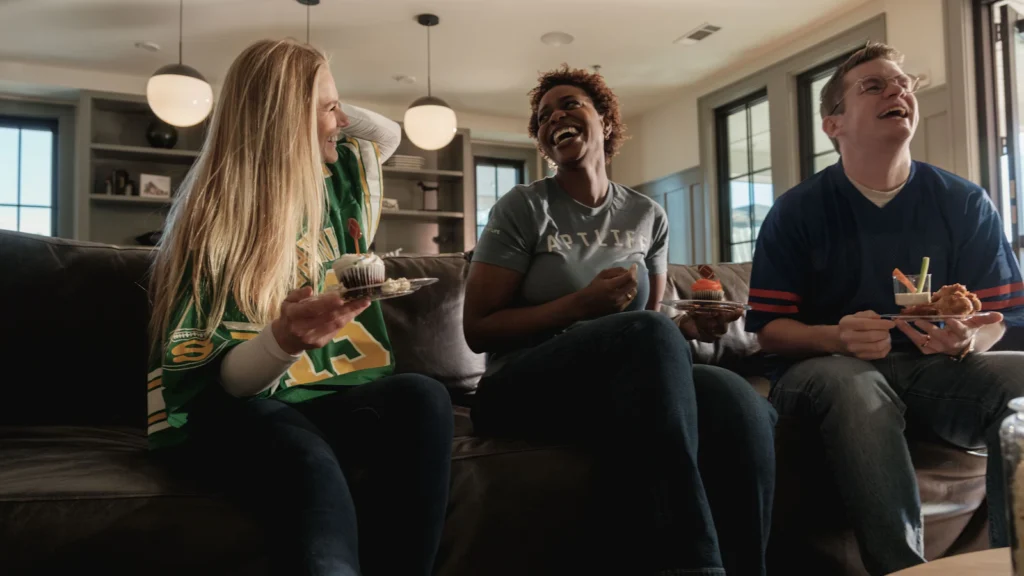
A teen Christmas party does not need a basement, gym or backyard. The right games can make a living room, classroom corner or apartment feel lively without running, rough play or moving furniture. These Christmas games for teens in small spaces use chairs, a table and quick team challenges that do not feel childish.
Most work for 4–16 players and take 5–15 minutes. Choose three or four, keep one backup and stop a game while people are still enjoying it. For a mixed-age gathering, also see our Christmas charades words and phrases.
Small-space game picker
| Game | Players | Time | Supplies |
|---|---|---|---|
| Secret Side Quest | 6–16 | 20 min in background | Task cards |
| Christmas Taboo | 4–12 | 12 min | Word cards, timer |
| Playlist in Five | 4–16 | 10 min | Paper or phones |
| Holiday Plot Twist | 4–12 | 12 min | Prompt cards |
| Tabletop Escape Envelopes | 4–16 | 15 min | Four envelopes |
17 Christmas games teens can play in a small room
1. Secret Side Quest
Give each player a private, harmless mission at the door: get someone to say “snow,” make two people compare favorite snacks or persuade the group to hum a song. Players complete tasks naturally during the party, then reveal them after 20 minutes. Ban filming, touching and embarrassing dares.
2. Christmas Taboo
Players describe a holiday word without using five obvious clue words. For “snowman,” the forbidden list might include snow, cold, carrot, winter and Frosty. Play in pairs so nobody is alone in front of the room. Allow 45 seconds per card.
3. Playlist in Five
Teams have five minutes to choose five songs for a fictional holiday scene: a snowy road trip, the final school day or a midnight snack run. They must agree on the order and create a playlist name. No music needs to be played.
4. Holiday Plot Twist
Give each group three cards: a character, a place and a problem. Examples are “an exhausted elf,” “a crowded bus” and “the gifts have the wrong names.” Teams write a six-sentence story and add a surprise final line. Reading aloud is optional.
5. Tabletop Escape Envelopes
Prepare four numbered envelopes: a picture rebus, word scramble, simple cipher and final combination. Groups solve them at one table. Put one hint on the back of every envelope and set a 15-minute limit.
6. Who Changed the Tray?
Place 12 small holiday objects on a tray. Players study them for 30 seconds, then close their eyes while the host removes or swaps one object. Everyone writes the change. Play five rounds and make changes progressively harder.
7. Christmas Emoji Relay—Without Running
Teams sit in rows. The first player sees an emoji phrase for ten seconds, then quietly describes it to the next person without saying the answer. The final player writes a guess. Rotate the starting player each round.
8. Two Truths and a Holiday Lie
Each team receives three prewritten statements about holiday films, songs or unusual traditions. They decide which statement is false. Using prepared facts keeps the game moving and avoids pressuring teens to reveal personal stories.
9. Snowball Question Toss
Everyone writes a light question on paper, crumples it and gently tosses it into a basket—not at other players. Each person draws one and may answer, trade or pass. Good prompts include “best holiday snack?” and “which movie deserves a sequel?”
10. One-Word Movie Clues
A player gives one word to help teammates guess a Christmas movie. The team gets one guess; if wrong, the next teammate adds one new word. No acting or quotations. Award two points if solved in three clues and one point after that.
11. Candy Cane Categories
Choose a letter, then name categories one at a time: gift, food, film character, winter activity. Players write an answer for each. Unique valid answers earn two points; duplicates earn one. Keep the focus on creativity instead of speed.
12. Pass the Drawing
Each player draws the top half of a holiday character, folds the paper to hide most of it and passes it right. The next person adds the middle, and a third adds the legs. Open the drawings together. This creates a funny reveal without putting anyone on stage.
13. Phone Photo Zoom Quiz
Before the party, photograph extreme close-ups of safe objects in the room: ribbon texture, a mug handle, a sweater pattern or a game controller. Show the images one at a time. Teams write guesses; nobody searches the room.
14. Holiday Ranking Debate
Give teams six items to rank, such as cookies, movie villains or winter drinks. They have four minutes to agree on one order and one sentence defending the top choice. The point is negotiation, not proving an objective answer.
15. Silent Line-Up Cards
Hand out cards numbered 1–10 or labeled with months. Without speaking or leaving their seats, players use hand signals to arrange the cards in order around the table. Add a second round with scrambled song lyrics or stages of wrapping a gift.
16. Guess the Sound
Play five-second audio clips recorded in advance: tape ripping, keys jingling, paper crumpling or a fizzy drink opening. Teams identify the sound. Keep the volume comfortable and show a written clue for anyone who prefers not to listen.
17. Mini Gift-Wrap Design Challenge
Teams receive one small box, one sheet of paper, 30 cm of tape and one ribbon. In eight minutes they create the most original package while remaining seated. Judge neatness, creativity and easy opening—not speed alone.
Copy-ready prompts for three small-space games
Use these directly from a phone or copy them onto scrap paper. Keep every challenge private to the room and let any player swap a prompt without explaining why.
12 Christmas Taboo cards
| Target word | Do not say |
|---|---|
| Stocking | sock, fireplace, hang, gifts, red |
| Snowman | snow, carrot, cold, Frosty, melt |
| Wrapping paper | gift, tape, bow, cover, present |
| Reindeer | Santa, antlers, sleigh, Rudolph, fly |
| Gingerbread | cookie, house, icing, bake, man |
| Christmas lights | tree, bright, bulbs, string, decorate |
| Ugly sweater | clothes, wear, jumper, contest, pattern |
| Hot chocolate | drink, warm, cocoa, mug, marshmallow |
| Christmas movie | film, watch, actor, screen, holiday |
| Candy cane | sweet, red, white, stripe, peppermint |
| Advent calendar | December, doors, countdown, chocolate, days |
| Secret Santa | gift, name, exchange, surprise, coworker |
8 Secret Side Quest prompts
- Get two people to agree on the best winter snack.
- Persuade someone to invent a name for a fictional reindeer.
- Start a three-person ranking of holiday films without revealing your mission.
- Get someone to use the word “sparkly” naturally.
- Convince the group to choose a theme song for the room.
- Find two people who prefer the same winter drink.
- Ask someone to describe an imaginary gift using exactly three words.
- Get the group to name five things that are red without announcing a game.
Four-envelope tabletop puzzle sequence
- Envelope 1 — wrapping order: Copy this card: “Three boxes are blue, red and green. Green is last. Red is not first. Which color is first?” Answer: blue. Hint: cross out the colors that cannot be first. When a team explains its answer, hand it envelope 2.
- Envelope 2 — scramble: Copy “TOMELTISE” plus one extra letter “E.” Rearrange all nine letters into a holiday plant. Answer: MISTLETOE. Hint: it begins with M and ends with E. Accept the spoken or written answer, then hand over envelope 3.
- Envelope 3 — number code: Copy “A=1, B=2, C=3 … Z=26” and “19-14-15-23.” Answer: SNOW. Hint: 19 means S. Give envelope 4 after the team decodes the word; keep every envelope on the same table.
- Envelope 4 — gift-tag logic: Copy: “Three gift tags show a star, a bell and a tree. The bell belongs to Bo. Ari does not have the tree. Which tag belongs to Cam?” Answer: tree. Hint: assign Bo first, then Ari. The host hands the team a finish card; nobody needs to leave their seat or search the room.
Small-room setup checklist: Keep one clear exit route, seat teams before explaining rules, place all paper and tape on one table, keep drinks on a separate surface, offer a pass role, and confirm that photos stay private unless every identifiable person agrees to sharing.
Set up for 4, 8, 12 or 16 teens
Use the same activities with different team sizes so a small room does not become a queue. These are planning suggestions, not a claim that the games have been personally tested.
| Guests | Team setup | What to copy | Host adjustment |
|---|---|---|---|
| 4 | Two pairs at one table | Two puzzle sets and one shared Taboo deck | Both pairs solve at the same time; take turns describing cards. |
| 8 | Four pairs | Four puzzle sets and four answer sheets | Give each pair its own envelope sequence to prevent waiting. |
| 12 | Four teams of three | Four puzzle sets | Rotate reader, solver and recorder after every envelope. |
| 16 | Four teams of four | Four puzzle sets plus one host answer key | Add a checker role; use written answers if several conversations get loud. |
Copy-ready host card and answer key
Write each envelope question on its own card and keep the answers on a separate host sheet. Read this before starting: “You have 15 minutes. Stay at your table. Work through envelopes 1 to 4 in order. You can ask for a hint, pass on reading aloud or share the writing role. This is a team puzzle, and nobody is eliminated.”
Host answer key: 1 = blue; 2 = MISTLETOE; 3 = SNOW; 4 = tree. Give one point per solved envelope, including answers reached with a hint. If teams finish together, share the win. At 12 minutes, offer the next hint to every unfinished team; at 15 minutes, reveal the remaining answers together.
- Read every question and answer once before guests arrive. Count the scramble letters and check that each team has all four cards.
- Offer large print, a spoken reading or a shared recorder. Avoid scoring reading speed, handwriting or spelling when the intended answer is clear.
- Keep the answer key off the player cards. For a phone-free party, copy the questions by hand or print only this section using your browser’s selection-print option when available.
- For familiar holiday vocabulary, swap the plant scramble for a winter word your group knows; tell everyone if you change a puzzle. Do not assume every guest celebrates Christmas.
For more word cards, see our Christmas games planning hub. Keep the seated format for this page; larger gatherings can use the separate large-group Christmas party plan.
A 60-minute plan for 8–12 teens
- 0–10 minutes: Secret Side Quest begins as guests arrive.
- 10–22 minutes: Christmas Taboo in pairs.
- 22–35 minutes: Who Changed the Tray?
- 35–50 minutes: Tabletop Escape Envelopes.
- 50–60 minutes: Reveal side quests and play one tie-breaker.
Rules that protect a small room
- Keep everyone seated or standing behind their own chair.
- No throwing objects at people, climbing, blindfolded walking or touching decorations.
- Use teams of two to four so quieter teens can contribute.
- Never require photos or posting to social media.
- Give each game a visible time limit and one practice round.
- Clear drinks away from paper, phones and game supplies.
For a church setting, adapt these ideas with our Christmas games for church youth groups. For a family party with younger and older players, use our Christmas games for families, kids and grandparents.
Frequently asked questions
What is the best Christmas game for shy teens?
Start with a written team game such as Candy Cane Categories or the Photo Zoom Quiz. Both let players contribute quietly before any discussion.
How many games should I plan for a two-hour teen party?
Plan four main games and two short backups. Food, conversation and transitions usually fill more time than expected.
Can these games work without prizes?
Yes. Let the winning team choose the next song, snack order or final game. If you use prizes, small snacks or $5 gift cards are enough.
How do I stop phones from taking over?
Use phones intentionally for one activity, such as the photo quiz or playlist draft, then place them face down for the next round. Avoid confiscating them; make the game faster and more interesting than scrolling.
Editorial note: This guide was created with AI assistance and reviewed for clarity, practicality and originality by the Easy Group Games editorial team.
Leave a Reply