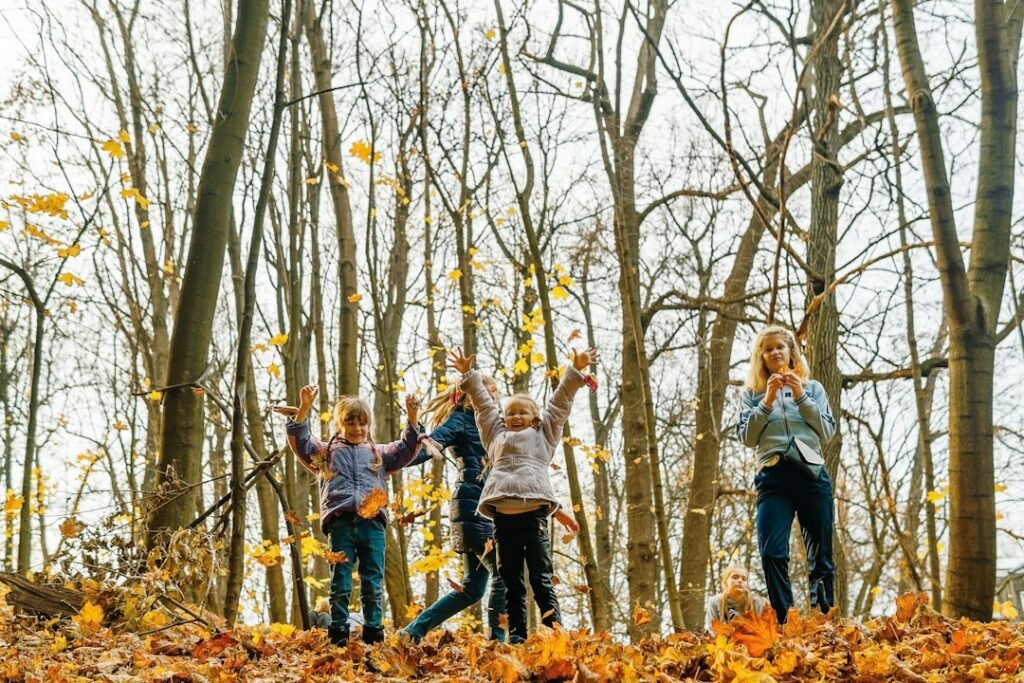
A church harvest family night has to work for more than one age group at once. Preschoolers may arrive ready to move, teenagers may be helping at stations, adults may be meeting new families and older guests may prefer a seated role. The best games give everyone a clear way to join without making the evening feel like a children-only carnival.
These 17 games use a warm harvest theme rather than frightening imagery. For a specifically Halloween-focused youth event, see our Halloween church games for youth groups and fall festivals.
Quick planning guide
| Setting | Best option | Volunteers |
|---|---|---|
| Arrival station | Harvest Gratitude Wall | 1 |
| Large hall | Family Harvest Relay | 3 |
| Small fellowship room | Autumn Picture Charades | 1 |
| Mixed mobility | Tabletop Pumpkin Roll | 2 |
| Outdoor lawn | Harvest Trail Challenge | 4 |
| No-prep backup | Thankful Categories | 1 |
Welcoming arrival games
1. Harvest Gratitude Wall
Time: ongoing | Supplies: paper leaves, tape and markers
Guests write one thing they appreciate on a paper leaf and add it to a large tree outline or display board. A volunteer can write for younger children or anyone who prefers to dictate. At the end, read a small selection without identifying writers unless they have agreed.
2. Find Your Harvest Match
Players: any number | Time: 8 minutes
Prepare matching picture pairs such as apple and basket, corn and field, leaf and tree, or bread and wheat. Give one card to each arriving guest. Players mingle to find the matching picture, then introduce themselves and answer a simple prompt such as “What is your favorite thing about autumn?” Make a few sets of three when attendance is uneven.
3. Autumn Name Circle
Players: 5–20 per circle | Time: 10 minutes
Each person says their name and a favorite autumn food, color or activity. The next person repeats one previous answer before adding their own. Do not require perfect memorization; the group may help. This keeps the opener friendly instead of turning it into a test.
Active family-team games
4. Family Harvest Relay
Players: teams of 4–8 | Time: 15 minutes | Supplies: baskets and soft fabric produce
Teams move one item at a time from a “field” basket to a “market” basket. Every round uses a different safe movement: normal walking, side steps or carrying the basket together. Create a shorter seated lane where players pass items hand to hand. Never require balancing on the head, running on hard floors or carrying heavy pumpkins.
5. Pumpkin Patch Beanbag Toss
Players: all ages | Time: 3 minutes per turn
Paint or tape pumpkin shapes around holes in a toss board, or place baskets at three distances. Children throw from the nearest line, adults from farther back and seated players choose any comfortable position. Score one, two or three points by distance. Use fabric beanbags rather than real produce.
6. Scarecrow Dress-Up Team Challenge
Players: teams of 4–6 | Time: 10 minutes
Provide oversized shirts, hats, scarves and clean fabric strips. One volunteer from each team stands comfortably while teammates create a scarecrow look over regular clothing. Do not wrap faces, necks or limbs. Replace speed judging with categories such as most colorful, best teamwork and funniest hat.
7. Harvest Trail Challenge
Players: families | Time: 15–20 minutes
Create five short stations: identify a leaf, carry a soft apple to a basket, solve an autumn riddle, make an animal sound and complete a gratitude prompt. Families collect a stamp at each station. The goal is to finish together, not race. Keep paths well lit and accessible for strollers and mobility aids.
8. Cornfield Direction Game
Players: 8–30 | Time: 10 minutes
Mark four sides of the room as barn, orchard, field and market. Call a location and guests walk to that side. Add gentle instructions: greet someone new, make a leaf shape with your hands or name an autumn food. Nobody is eliminated; the final call brings everyone to the center for the next activity.
Small-space and seated games
9. Tabletop Pumpkin Roll
Players: 2–6 per table | Supplies: orange soft balls and paper cups
Arrange cups as targets at the end of a table. Players roll a soft orange ball and score the cup it touches. Use a table edge guard or a volunteer to catch missed rolls. This works well for intergenerational teams and guests who prefer to remain seated.
10. Autumn Picture Charades
Players: 4–20 | Time: 15 minutes
Use simple picture prompts: raking leaves, baking bread, picking apples, migrating birds or carrying an umbrella. Players may act, draw or describe without saying the answer, allowing different comfort levels. Keep teams mixed by age so reading ability is not an advantage.
11. Thankful Categories
Players: 4–15 | Time: 8 minutes | Supplies: none
Choose an encouraging category such as people who help us, foods we enjoy, places that feel welcoming or skills we are learning. Move around the circle with one new answer per person. Pause the countdown for anyone who needs more processing time and allow a partner to help.
12. Harvest Sound Story
Players: 6–30 | Time: 10 minutes
Assign sections of the room a sound: wind, rain, tractor, birds or crunching leaves. A narrator tells a short journey to a harvest celebration and points to each section when its sound belongs in the story. Keep volume comfortable and offer quiet hand motions as an alternative.
13. Basket Memory Challenge
Players: 3–8 per table | Time: 10 minutes
Place eight large, safe autumn objects in a basket. Guests study them for 30 seconds, then the leader covers the basket and removes one item. Teams identify what changed. Use fewer objects for younger children and tactile descriptions for guests with limited vision.
Meaningful closing games
14. Pass the Kind Word
Players: 5–12 per circle | Time: 10 minutes
Pass a soft fabric leaf around the circle. The holder thanks someone in the room, recognizes a volunteer or names one helpful action they noticed. Guests may pass without speaking. Keep comments short so the activity remains comfortable and inclusive.
15. Harvest Story Builders
Players: 4–12 | Time: 12 minutes
Start with, “The smallest seed in the field had a very big plan.” Each person adds one or two sentences. Before beginning, choose whether the story should be funny, adventurous or reflective. A leader can repeat the story so younger children can follow.
16. Family Five-Question Quiz
Players: family teams | Time: 10 minutes
Ask five accessible questions about autumn nature, foods and community traditions. Give every team a paper to record one shared answer. Include one observation question, one picture question and one “name three” challenge so the quiz does not depend only on facts.
17. One-Minute Service Ideas
Players: family teams | Time: 8 minutes
Give teams one minute to list small ways a family could help during autumn: collect food-bank items, check on a neighbor, write thank-you notes or help clean after an event. Each team shares one idea not already mentioned. End by choosing one realistic action the congregation can support.
A practical 90-minute family-night schedule
Use the Gratitude Wall during the first 15 minutes. Welcome everyone, explain safety and divide families into mixed-age teams. Run three 12-minute stations with three-minute transitions. Allow 15 minutes for refreshments, then use Harvest Sound Story and Pass the Kind Word as the closing sequence. Keep one volunteer unassigned so they can help with late arrivals, spills or accessibility needs.
Volunteer and safety checklist
- Use soft props and stable targets; avoid real pumpkins in throwing games.
- Keep emergency exits, ramps and walkways clear.
- Offer seated versions at every active station.
- Photograph children only with the congregation’s required permission.
- Use visible ingredient labels if food is served.
- Give every volunteer a station script, time limit and named supervisor.
- Avoid elimination so families arriving late can join immediately.
For related seasonal planning, explore fall classroom games, Canadian Thanksgiving classroom games and Christmas games for church youth groups.
For an adults-only gathering with zero preparation, try these fall party games for adults without supplies.
Planning specifically for November? These Thanksgiving games for church groups without printables include fellowship, youth-ministry and mixed-age options.
Planning the next seasonal gathering? Our Christmas party games for large groups include scalable family, church and community ideas.
Frequently asked questions
How many games should a church family night include?
Three or four structured stations are enough for a 90-minute event. Leave time for arrival, food, transitions and conversation rather than filling every minute.
How can games work for children and seniors together?
Use family teams, large visible props, adjustable throwing lines and seated alternatives. Give players roles such as scorekeeper, clue reader, thrower or encourager.
What is a good no-prep harvest game?
Thankful Categories and Autumn Name Circle need no equipment. Harvest Sound Story also works without supplies if the leader improvises the narration.
Leave a Reply