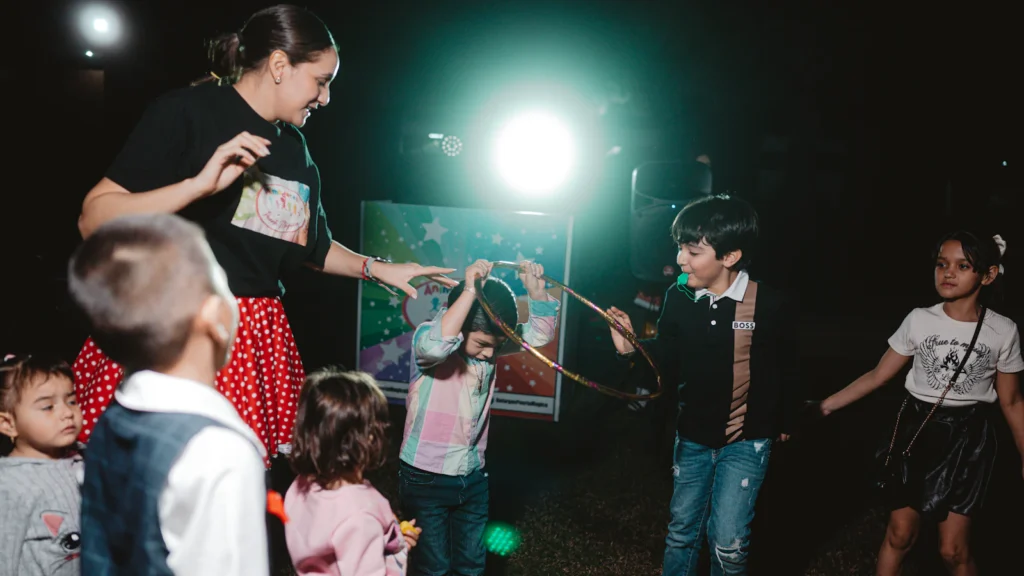
A neighborhood Halloween party needs games that make sense for people who arrive at different times, children of different ages, and adults who may be talking while they supervise. The best activities are easy to see, quick to join, and simple to reset between rounds.
These 17 games work on a driveway, closed street, shared courtyard, or community lawn. Most use household items, avoid long elimination rounds, and can run as drop-in stations. Always follow local rules for street closures and keep play well away from moving vehicles.
Quick chooser
- No supplies: Monster Freeze, Witch Says, Costume Corners, or Ghost Detective
- Small driveway: Pumpkin Balance, Spider Step, or Mystery Sound
- Large crowd: Neighborhood Monster Hunt, Glow Relay, or Halloween Parade Challenges
- Mixed ages: Candy Color Dash, Friendly Ghost Tag, or Pumpkin Pass
- After dark: Flashlight Shapes or Glow-Stick Trail, with adult boundary monitors
17 neighborhood Halloween games
1. Monster Freeze
Time: 5 minutes | Players: 6–40
Play music from a phone or simply clap a beat. Everyone moves like a chosen monster and freezes when the sound stops. Instead of eliminating anyone who wiggles, ask them to choose the next monster movement. This keeps toddlers, teens, and adults involved.
2. Costume Corners
Time: 8 minutes | Players: 8–50
Designate four visible corners: funny, spooky, magical, and heroic. Call a prompt such as “the costume you would wear for a movie” and players move to a corner. Invite one person from each group to explain the choice. Nobody needs to be wearing a costume to play.
3. Neighborhood Monster Hunt
Time: 15 minutes | Players: teams
Choose visible objects around the party zone: an orange door, a broom, a carved pumpkin, something purple, and a friendly monster. Teams find or point to each item without entering private property. A phone photo can count, but never photograph children without permission.
4. Pumpkin Pass
Time: 6 minutes | Players: circles of 6–12
Pass a small pumpkin or orange ball while a leader counts backward from twenty. Whoever holds it at zero performs a silly action—owl hoot, zombie walk, or witch laugh—then begins the next round. Use a soft ball for younger groups.
5. Spider Step
Time: 8 minutes | Players: 4–20
Place chalk marks or paper “webs” across a driveway. Players cross by stepping only on the webs. Move the marks farther apart for older players and closer for young children. Run one person at a time and keep the course dry and well lit.
6. Witch Says
Time: 5 minutes | Players: any group
Use commands such as stir the cauldron, fly in slow motion, duck from a bat, or tiptoe past a sleeping dragon. Players act only when the leader says “Witch says.” Mistakes earn a funny reset pose, not elimination.
7. Candy Color Dash
Time: 6 minutes | Players: 8–30
Assign four safe spots a color. Call a color plus a movement: hop to orange, sneak to purple, march to green. Players move without racing or pushing. Add “rainbow” to make everyone freeze in place.
8. Friendly Ghost Tag
Time: 8 minutes | Players: 8–24
One ghost tags players with a gentle shoulder tap. Tagged players freeze with hands overhead until a neighbor frees them by saying their first name or giving an agreed air high-five. Mark clear boundaries and change the ghost every minute.
9. Mystery Sound
Time: 10 minutes | Players: teams
Hide ordinary objects behind a chair or inside a box and make a sound: shake keys, tear paper, tap a cup, zip a jacket, or crunch dry leaves. Teams write or whisper guesses. The everyday sounds are surprisingly difficult when players cannot see the source.
10. Pumpkin Balance Walk
Time: 8 minutes | Players: relay teams
Players carry a mini pumpkin, beanbag, or orange on a paper plate through a short walking course. If it falls, they return to the previous marker. Keep the route straight for small children and add one gentle turn for older players.
11. Ghost Detective
Time: 7 minutes | Players: 6–20
One detective closes their eyes while the group silently chooses a “ghost.” Everyone makes the same quiet spooky motion, but the ghost subtly changes it. The detective gets three guesses to spot the leader. Rotate quickly so several people lead.
12. Glow Relay
Time: 10 minutes | Players: teams
Teams carry a glow stick or battery tea light around two visible markers and back. Walking—not sprinting—is the rule after dark. Give each team a different movement, such as giant steps or a careful mummy walk. Never use open flames.
13. Flashlight Shapes
Time: 8 minutes | Players: small teams
A leader calls a shape or simple object. Teams use flashlight beams on a blank wall or garage door to create it together. Try a triangle, cat ears, pumpkin face, or the letter B. Confirm permission before shining light on any home.
14. Halloween Parade Challenges
Time: 10 minutes | Players: any group
Instead of judging costumes, lead a short parade with inclusive challenges: best slow-motion walk, funniest wave, strongest superhero pose, quietest tiptoe, or most creative group freeze. Players without costumes compete equally.
15. Mummy Team Shape
Time: 7 minutes | Players: teams of 4–6
Call an object—pumpkin, bat, haunted house, number eight—and teams use their bodies to create the shape. They have twenty seconds, then freeze for a photo only if everyone has consented. Award applause for teamwork rather than appearance.
16. Glow-Stick Trail
Time: 10 minutes | Players: one at a time
Create a short trail using glow sticks or battery lights on the ground. Players follow it while completing three actions: step over a chalk line, circle a cone, and whisper a password to the finish monitor. Adults supervise both ends, and the route stays inside the party boundary.
17. The Missing Treat Bowl
Time: 10–12 minutes | Players: whole group
Tell players a pretend treat bowl has vanished. Give three spoken clues tied to safe public areas: “I can see something orange,” “I am near a place to sit,” and “I am not past the lights.” Players solve the location as a group. Use an empty prop bowl so allergies and candy do not determine participation.
A one-hour block-party game plan
- 0–10 minutes: Monster Freeze welcomes early arrivals.
- 10–25 minutes: Run Spider Step and Pumpkin Balance as side-by-side stations.
- 25–40 minutes: Neighborhood Monster Hunt in family teams.
- 40–50 minutes: Halloween Parade Challenges.
- 50–60 minutes: The Missing Treat Bowl as the group finale.
Safety and hosting tips
- Use cones, chalk, or battery lights to mark the exact play area.
- Place one adult at each entrance and keep games away from traffic, cords, and open flames.
- Offer a quiet station for children who do not want loud music or touch-based games.
- Use applause, stickers, or team points instead of food prizes so allergies are not an issue.
- Ask before taking or posting photos, especially of children.
For a bigger crowd, use these Halloween games for large groups with no waiting. Hosting indoors instead? Try our Halloween family games at home. For a small household or porch group, see Halloween games for 3 to 8 players.
Frequently asked questions
How many games should a block party use?
For a 60–90 minute event, choose one continuous welcome game, two or three stations, and one group finale. More options can create clutter and require extra volunteers.
What if children arrive at different times?
Use drop-in games such as Monster Freeze, Spider Step, Mystery Sound, and Pumpkin Balance first. Save the hunt or finale until the largest group has arrived.
Can these games work without candy?
Yes. None requires candy. Use team points, applause, a neighborhood certificate, or the chance to lead the next round as rewards.
Leave a Reply