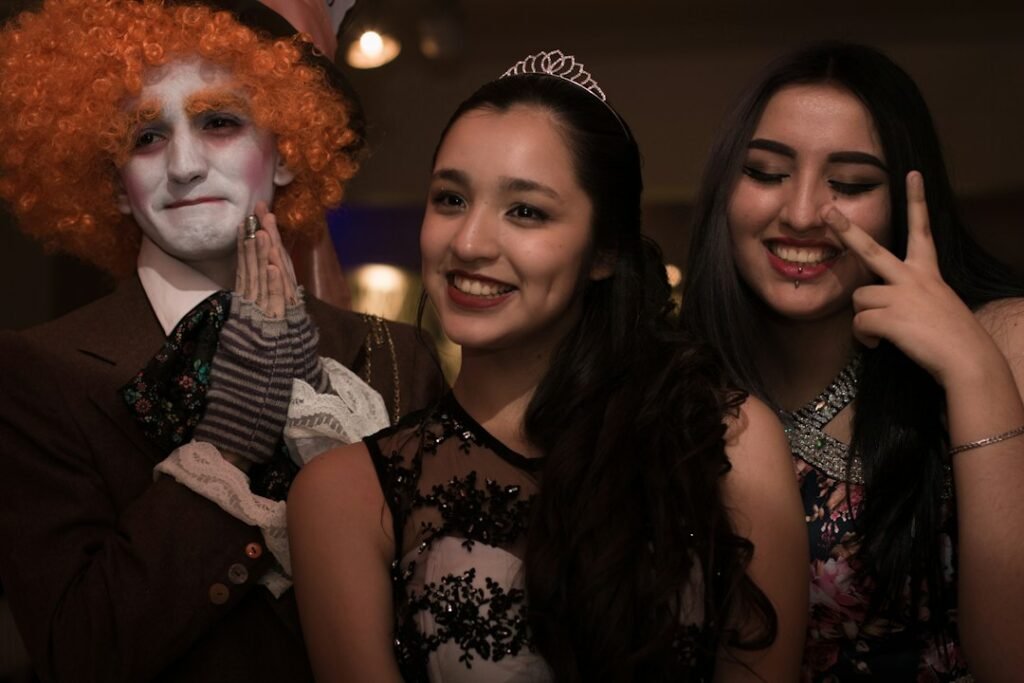
Dorm Halloween parties work best when the games are social, inexpensive and easy to stop when new people arrive. The ideas below need little space and no alcohol, so they suit residence halls, student apartments, campus clubs and mixed groups.
Quick chooser
- Small dorm room: Haunted Hot Seat, Monster Categories or Two Truths and a Fright.
- New group: Secret Monster, Costume Connections or Ghost Story Relay.
- Large floor event: Campus Crypt Hunt, Zombie Freeze or Human Clue.
- Quiet hours: Horror Movie Pitch, Spooky Password or Mystery Sound.
Before you start
Check residence-hall rules, keep hallways and exits clear, and set a clear end time. Use battery lights rather than candles. Tell guests that every challenge is optional and avoid pranks involving strangers, locked rooms, food allergies or realistic weapons.
17 Halloween games for college students
1. Secret Monster
Privately assign one guest as the monster. Everyone mingles and asks one another Halloween “would you rather” questions. The monster secretly winks at a player, who waits ten seconds and then gives a theatrical shriek. The group gets one accusation per round. For 8–20 players; allow 10 minutes.
2. Haunted Hot Seat
One player faces away from a written Halloween word. Teammates describe it without saying the word or obvious parts of it. Use familiar prompts such as haunted house, black cat, zombie and candy corn. Score one point for each answer in 45 seconds.
3. Dorm-Room Mystery Sound
A host makes a sound behind a blanket using ordinary objects: keys dragged across a mug, paper crumpled slowly or water poured into a cup. Teams write one guess. Reveal the harmless source after every round; never create sounds in the corridor that could alarm residents.
4. Two Truths and a Fright
Each person shares two true stories and one invented spooky story. The group votes on the fiction. This is especially good for roommates who are still getting acquainted and needs no supplies.
5. Horror Movie in 60 Seconds
Teams receive a familiar movie or a broad prompt such as “cursed group chat.” They get three minutes to plan a one-minute performance. Award playful titles for clearest plot, funniest special effect and best dramatic ending.
6. Campus Crypt Hunt
Create clues that lead only to permitted public places such as a common room noticeboard, laundry-room entrance or courtyard bench. Teams photograph each location instead of taking objects. Keep groups together and define an accessible route and firm return time.
7. Monster Categories
Name a category—Halloween films, things in a haunted house, costume ideas or orange foods. Moving around the circle, players must answer within three seconds without repeating. A hesitation earns a letter in GHOST; the last player without the full word wins.
8. Spooky Password
Partners try to guess a secret Halloween word from one-word clues. Clues cannot rhyme, use gestures or contain part of the answer. Rotate partners after three words so guests meet more people.
9. Costume Connection
Guests have five minutes to form the largest group whose costumes share a defensible connection. A pirate, astronaut and detective might all be “explorers.” Each group presents its link; creativity matters more than perfection.
10. Ghost Story Relay
Sit in a circle. The first player begins with one sentence, and each person adds exactly one sentence. Add a rule midway—every new line must mention an object visible in the room—to keep the story specific and funny.
11. Human Clue
Give volunteers simple roles, a location and a harmless missing object. Guests interview them for five minutes, then teams decide who hid the object, where and why. Keep the plot light and provide a written solution so the ending feels fair.
12. Zombie Freeze
Play music at a comfortable volume. Everyone moves like a zombie until the host pauses it; anyone caught moving completes a silly, non-embarrassing prompt and rejoins. Nobody is eliminated, so late arrivals can enter easily.
13. Cursed Object Pitch
Hand each team an ordinary dorm item. They have two minutes to invent its curse and pitch it like a late-night advertisement. The audience votes for funniest, most believable and least useful curse.
14. Emoji Horror Titles
The host describes film titles or spooky phrases using three to five emoji shown on a phone or spoken aloud. Teams guess on paper. Include easy and international-friendly prompts so niche movie knowledge does not decide the whole game.
15. The Roommate Alibi
Pairs receive 60 seconds to agree on an alibi for a fictional event, such as “Who ate the last pumpkin cookie?” Separate them and ask the same five questions. Each matching answer earns a point.
16. Halloween Debate Dash
Read low-stakes choices: ghosts or vampires, sweet or sour candy, scary movie or comedy. Players move to one side of the room and have 30 seconds to persuade the undecided. Keep a seated hand-signal option for accessibility.
17. Final Survivor Trivia
Ask a mix of Halloween history, pop culture and campus-life questions. Everyone answers with fingers for multiple choice, so no materials are required. Let wrong answers stay in as “ghost helpers” instead of eliminating players.
A ready-to-run 60-minute plan
- 0–10 minutes: Costume Connection as guests arrive.
- 10–25 minutes: Haunted Hot Seat in teams.
- 25–40 minutes: Human Clue or Campus Crypt Hunt.
- 40–52 minutes: Horror Movie in 60 Seconds.
- 52–60 minutes: Final Survivor Trivia and prizes.
Low-cost prize ideas
Use a snack voucher, first choice of movie, a homemade certificate or the right to choose the next game. Offer a non-food alternative and avoid making guests pay to participate.
Planning the next dorm gathering? These Friendsgiving games for college students use the same alcohol-free, small-space approach.
Frequently asked questions
What games work in a very small dorm?
Choose seated games such as Haunted Hot Seat, Monster Categories, Spooky Password and Two Truths and a Fright. They fit 6–12 people without moving furniture.
How do I include guests who do not drink?
Make every activity alcohol-free by design and serve several appealing drinks. The game should be the event, not a penalty attached to drinking.
How many games are enough?
Plan three main games and keep two quick backups. College gatherings change size quickly, so flexible rounds are more useful than a packed timetable.
For an older mixed group, see our Halloween party games for adults. Planning for younger siblings too? Try these Halloween games for teens and tweens.
Leave a Reply