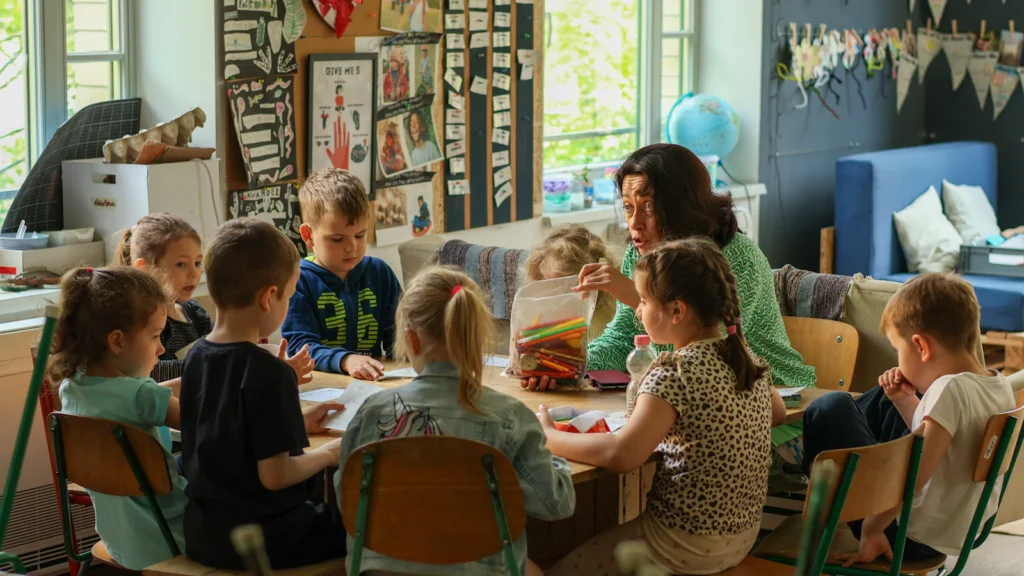
Indoor recess works best when students can begin quickly, understand the boundaries, and stop without a ten-minute cleanup. These 19 rainy-day classroom games need no printable cards or purchased equipment. Most use only voices, movement, a board, or scrap paper already in the room.
The activities are designed mainly for elementary classrooms, with adaptations for younger and older students. Alternate active games with quiet ones, and keep movement inside a clearly marked safe zone.
Quick chooser
- Very small classroom: Silent Detective, Mirror Leader, or Twenty Questions
- Quiet option: Word Chain, Mystery Sound, or Group Count
- Movement break: Traffic Lights, Corner Challenge, or Animal Motion Relay
- Whole class: Reverse Charades, Categories, or Secret Leader
- Five-minute filler: Statue Themes, Would You Rather, or Last Letter
19 no-prep indoor recess games
1. Silent Detective
Time: 7 minutes | Group: whole class
One detective closes their eyes while the class chooses a leader. Everyone copies the leader’s small movements. The detective gets three guesses. Use seated movements when space is tight and change leaders each round.
2. Traffic Lights
Time: 5 minutes | Group: whole class
Green means walk in place, yellow means slow motion, and red means freeze. Add blue for sit, purple for stretch, and orange for a silent pose. Students stay beside their desks rather than moving across the room.
3. Mirror Leader
Time: 6 minutes | Group: pairs
Partners face each other. One moves slowly while the other mirrors each motion. Switch after 30 seconds. Challenge older students to keep the leader unclear by moving smoothly.
4. Classroom Categories
Time: 8 minutes | Group: teams
Call a category such as animals, book characters, words beginning with T, things found outdoors, or foods with two syllables. Teams alternate answers with a three-second limit. Repeated answers end only that round.
5. Reverse Charades
Time: 10 minutes | Group: teams of 4–8
One student guesses while the rest of the team silently acts out the same action: brushing teeth, climbing a hill, opening a gift, or walking through mud. The group format keeps individual students from feeling exposed.
6. Mystery Sound
Time: 7 minutes | Group: whole class
Students close their eyes while the teacher makes an ordinary classroom sound: zip a backpack, turn pages, tap a pencil, open a drawer, or crumple paper. Students raise a quiet hand to guess. Let volunteers create safe sounds in later rounds.
7. Group Count
Time: 5 minutes | Group: whole class
The class counts from one to twenty without an assigned order. If two students speak at once, restart at one. No pointing or planning is allowed. Set a calm voice level and celebrate improvement rather than speed.
8. Secret Leader
Time: 8 minutes | Group: whole class
A student waits outside the circle or looks away. The class selects a leader who changes a repeated motion every few seconds. The returning student watches and has three guesses to identify the leader.
9. Last Letter
Time: 6 minutes | Group: circle or rows
One student says a word. The next gives a new word beginning with the final letter: cat, tree, egg, garden. Choose a topic for older students. Allow five seconds and avoid eliminating students; offer a class hint instead.
10. Corner Challenge
Time: 8 minutes | Group: whole class
Assign each corner a choice such as read, draw, build, or perform. Ask a question and students move to their preference. In crowded rooms, students point instead. Give each group 30 seconds to agree on one reason.
11. Animal Motion Relay
Time: 8 minutes | Group: teams
Students take turns doing a safe animal motion beside a desk—penguin steps, tall giraffe stretch, slow turtle, or quiet cat. Their team guesses the animal. There is no running, crawling under furniture, or contact.
12. Twenty Questions
Time: 8 minutes | Group: whole class
Choose a classroom object, animal, place, or story character. Students ask yes-or-no questions and have twenty chances to identify it. Pause after the round to notice which questions removed the most possibilities.
13. One-Sentence Story
Time: 10 minutes | Group: whole class
Begin with a safe prompt: “When the rain stopped, the playground had changed.” Each student adds one sentence of no more than ten words. Allow passes and end after one trip around the room.
14. Statue Themes
Time: 5 minutes | Group: whole class
Call a theme such as windy tree, tiny mouse, surprised scientist, sleepy giant, or superhero landing. Students freeze in place. Recognize clearest pose, best facial expression, and most original idea instead of choosing one winner.
15. Would You Rather
Time: 6 minutes | Group: whole class
Ask choices such as explore space or the ocean, talk to animals or understand every language, read minds or become invisible. Students vote with one or two fingers, then discuss one reason with a partner.
16. Desk-Side Scavenger Hunt
Time: 7 minutes | Group: whole class
Students remain by their desks and point to something matching each prompt: rectangular, softer than a book, beginning with P, used for measuring, or showing three colors. Nobody opens another student’s desk or leaves the room.
17. Teacher Says
Time: 5 minutes | Group: whole class
Use classroom-friendly commands: touch two elbows, make a triangle with fingers, silently count to five, or balance on one foot beside a desk. Mistakes earn a reset pose rather than elimination.
18. Invisible Object
Time: 8 minutes | Group: circle
A student mimes passing an invisible object with a clear weight, size, and texture. The next student receives it, changes one quality, and passes it on. At the end, ask students to describe how the object changed.
19. Three-Clue Classroom
Time: 8 minutes | Group: teams
Give three clues about a visible classroom item: “It is smaller than a chair, used every day, and has straight edges.” Teams get one guess after each clue. Students then create their own three-clue puzzles in pairs.
A ready 30-minute indoor recess rotation
- 0–5 minutes: Traffic Lights.
- 5–12 minutes: Mystery Sound.
- 12–22 minutes: Reverse Charades.
- 22–27 minutes: Group Count.
- 27–30 minutes: Statue Themes.
Indoor-recess safety and classroom management
- State the movement boundary and voice level before starting.
- Keep bags, cords, chairs, and wet coats out of walking paths.
- Use non-elimination rules so mistakes do not leave students bored.
- Offer seated roles such as caller, detective, clue-giver, or scorekeeper.
- Stop while engagement is still high and use a consistent cleanup signal.
For a fall theme, try these no-prep fall classroom games. Seasonal parties can use our non-candy Halloween school-party games. Older students may prefer these Thanksgiving games for middle school classrooms.
Frequently asked questions
What is the best indoor recess game for a small classroom?
Silent Detective, Mirror Leader, Mystery Sound, Group Count, Twenty Questions, and Last Letter work with students seated or standing beside desks.
How many games fit a 20-minute recess?
Choose one five-minute movement game, one eight-minute team game, and one quiet closer. Fewer well-run games are better than rushing through many.
Do these activities need preparation?
No printable materials are required. A board, scrap paper, or ordinary classroom objects are optional for a few variations.
Leave a Reply