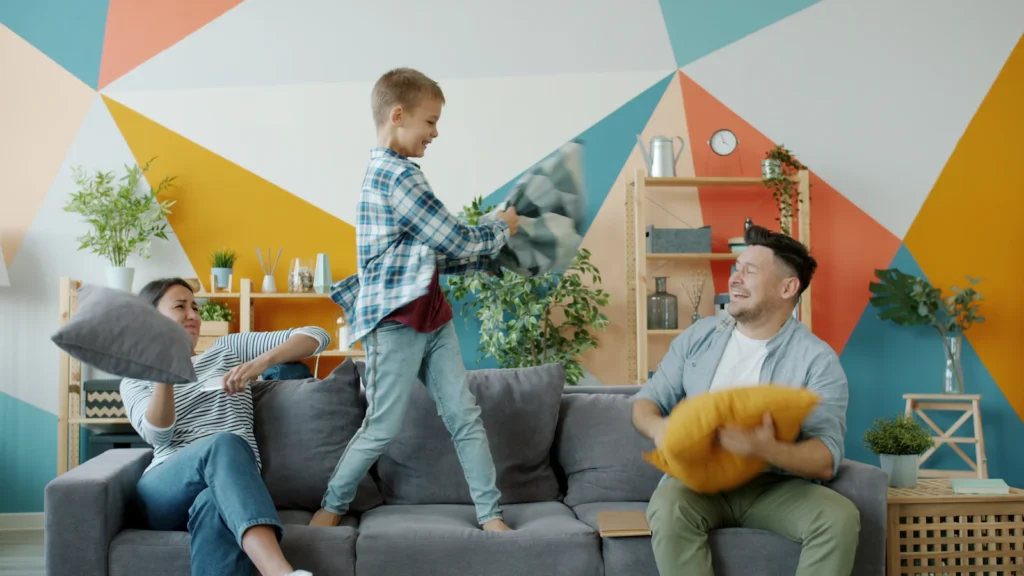
Rainy days become difficult when everyone is indoors, energy is high, and the obvious activities need craft materials or advance planning. These family games can start immediately with people, imagination, and ordinary space. A few offer optional scrap-paper variations, but none requires a printable, purchased prop, or special equipment.
The list includes quiet games, movement breaks, mixed-age challenges, and choices for small apartments. Use the quick chooser to match the activity to your room and the mood of the group.
Quick chooser
- Small apartment: Silent Detective, Mirror Moves, or One-Word Story
- High energy: Traffic-Light Moves, Animal Relay, or Floor-Is-Lava Leader
- Quiet time: Twenty Questions, Memory Chain, or Sound Detective
- Mixed ages: Family Categories, Reverse Charades, or Secret Leader
- Five minutes: Statue Challenge, Would You Rather, or Count to Twenty
21 no-supply rainy-day family games
1. Silent Detective
Time: 7 minutes | Players: 4+
One detective closes their eyes while the group chooses a leader. Everyone copies the leader’s small movements—tapping knees, blinking, stretching, or nodding. The detective gets three guesses. Change leaders quickly so several people get a turn.
2. Mirror Moves
Time: 5 minutes | Players: pairs
Partners face each other. One moves slowly while the other mirrors every action. Switch after 30 seconds. Older players can add facial expressions or change levels; younger children do better with simple hand and shoulder movements.
3. Family Categories
Time: 8 minutes | Players: 3+
Name a category such as animals, foods, things in a bathroom, movie characters, or words beginning with S. Move around the group, allowing three seconds per answer. Repeats sit out only for that round and return immediately.
4. One-Word Story
Time: 8 minutes | Players: 3+
Create a story one word at a time around the circle. Start with a helpful opening such as “Yesterday our umbrella suddenly…” Agree that the story ends after three rounds so it stays lively. Younger children may contribute a short phrase instead of one word.
5. Traffic-Light Moves
Time: 6 minutes | Players: 2+
The caller says green for moving, yellow for slow motion, and red for freezing. Add blue for sitting, purple for dancing, and orange for making a funny pose. Clear fragile items and use walking feet indoors.
6. Twenty Questions
Time: 8 minutes | Players: 2+
One player chooses a person, place, animal, or household object. Everyone else asks yes-or-no questions and has twenty chances to identify it. Encourage broad early questions—living or not, indoors or outdoors—before guessing specific answers.
7. Reverse Charades
Time: 10 minutes | Players: teams of 3+
One person guesses while the rest of the team acts out the same word together. Use easy actions such as brushing teeth, walking a dog, baking, swimming, or building a snowman. The group performance helps shy players participate without being singled out.
8. Sound Detective
Time: 7 minutes | Players: 2+
The detective closes their eyes. Another player makes an ordinary sound—zipping a jacket, tapping a table, rubbing hands, opening a cupboard, or turning pages. The detective identifies the sound in three guesses. Avoid anything breakable or startling.
9. Memory Chain
Time: 8 minutes | Players: 3+
Begin, “On our rainy-day trip, I packed…” and name one item. Each person repeats the list and adds another item. For younger children, allow mime clues. For older players, require every new item to begin with the next letter of the alphabet.
10. Count to Twenty Together
Time: 5 minutes | Players: 3+
The group must count from one to twenty, but nobody decides the speaking order. If two people say the same number at once, restart at one. No pointing or assigned turns. The game quickly teaches patience, listening, and shared rhythm.
11. Secret Rule
Time: 10 minutes | Players: 4+
One player leaves briefly while the group chooses a simple rule: answer every question with a color, touch your nose before speaking, or copy the person on your left. The returning player asks questions and tries to discover the rule. Keep the rule visible and kind, never embarrassing.
12. Animal Relay Without Running
Time: 8 minutes | Players: teams
Mark a short route between two walls or chairs. Players take turns moving like an animal—penguin steps, slow turtle, tall giraffe, or quiet cat—then walk back. The next player chooses a different animal. Focus on creativity rather than speed.
13. Would You Rather: Home Edition
Time: 6 minutes | Players: any
Ask playful choices: a room made of pillows or books, talk to pets or understand birds, cook every meal or wash every dish, explore space or the ocean. Players show one or two fingers and give one reason. Avoid choices that expose money, fears, or family conflict.
14. Floor-Is-Lava Leader
Time: 6 minutes | Players: 2+
Instead of jumping on furniture, the leader calls safe “islands”: a rug, a taped area, or a specific floor tile. Everyone walks to an island before a five-count. Never climb, leap over objects, or use unstable cushions.
15. Statue Challenge
Time: 5 minutes | Players: 2+
Call a theme—superhero, sleepy giant, surprised chef, windy tree, or tiny mouse. Players have three seconds to freeze in a pose. Award categories such as funniest, clearest, most unexpected, and best teamwork so there is no single winner.
16. The Question Ball Without a Ball
Time: 7 minutes | Players: 3+
Mime throwing an invisible ball to someone and ask a light question: favorite rainy-day snack, dream animal, best sound, or a skill to learn. The receiver answers, “throws” the ball onward, and asks a new question.
17. Two Truths and a Tall Tale
Time: 10 minutes | Players: 3+
Each person shares two true, harmless statements and one invented statement. Others identify the tall tale. Children may use facts about favorite things rather than personal experiences. Adults should model short, guessable examples.
18. Forbidden Word
Time: 8 minutes | Players: 3+
Choose a common word such as yes, no, I, or rainy. One player asks rapid, friendly questions while the answerer tries to avoid the forbidden word for 30 seconds. Switch roles after each round. Keep questions simple for young children.
19. Family Commercial
Time: 12 minutes | Players: teams
Teams choose an ordinary object already visible, such as a spoon, sock, umbrella, or cushion. They have three minutes to invent a 30-second commercial with a product name, unusual benefit, and slogan. Perform it live; recording is optional and only with everyone’s permission.
20. The Five-Second Expert
Time: 8 minutes | Players: 3+
Name a safe topic—dinosaurs, breakfast, clouds, sports, or cats. A player speaks like an expert for five seconds without pausing. The next player gets a new topic. For older groups, increase to ten seconds or require three facts, even if silly.
21. Invisible Obstacle Course
Time: 10 minutes | Players: 2+
The leader narrates an imaginary course: step over a stream, crawl under a laser, balance across a bridge, squeeze through a cave, and tiptoe past a dragon. Players act it out within their own space. Keep movements slow and avoid real furniture obstacles.
A ready one-hour rainy-day plan
- 0–8 minutes: Traffic-Light Moves to burn off initial energy.
- 8–18 minutes: Reverse Charades.
- 18–28 minutes: Sound Detective as a calmer reset.
- 28–42 minutes: Family Commercial in teams.
- 42–52 minutes: Invisible Obstacle Course.
- 52–60 minutes: One-Word Story while everyone settles.
Make the games work in a small home
Define one safe movement zone and keep everyone at least an arm’s length apart. Alternate active and quiet games instead of running several energetic activities in a row. Give children who prefer not to perform useful roles such as caller, timer, sound maker, or detective. Stop before the group becomes tired; a 20-minute sequence that ends well is better than an hour everyone resists.
If the adults want a separate round, use our indoor group games for adults in small spaces. Older children may enjoy these indoor fall games for teens, while a friends-only gathering can use games to play with friends at home without supplies.
Frequently asked questions
What is the best rainy-day game for mixed ages?
Reverse Charades, Family Categories, and Family Commercial work especially well because younger players can act or suggest ideas while older players explain and organize.
Which games are quiet enough for an apartment?
Try Silent Detective, Mirror Moves, Twenty Questions, Sound Detective, Memory Chain, Count to Twenty, or One-Word Story. Set a speaking-volume rule before beginning.
How can two people play?
Mirror Moves, Twenty Questions, Sound Detective, Would You Rather, Forbidden Word, and Invisible Obstacle Course all work with two players.
Leave a Reply