17 Indoor Group Games for Adults in Small Spaces
Updated By Easy Group Games Editorial Team
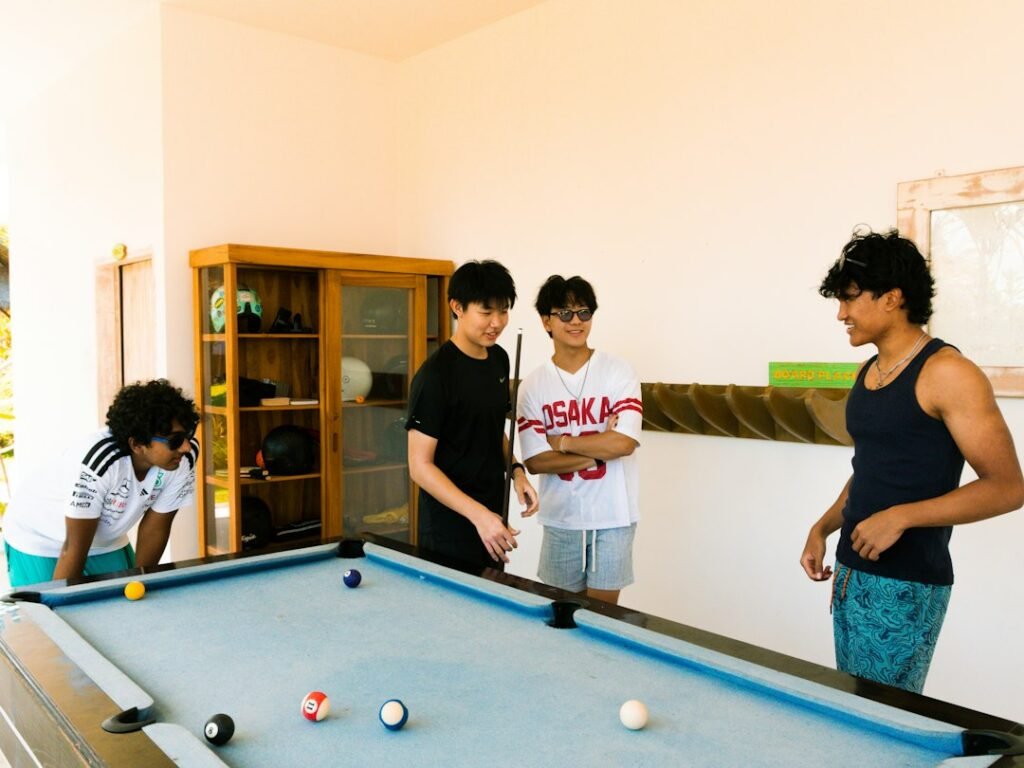
A small living room can host a genuinely good game night. The trick is choosing activities that do not require running, fragile props or one person performing under pressure. These indoor group games for adults work in apartments, dining rooms, offices and rainy-day gatherings.
Before guests arrive, move breakable items away from the main seating area and decide where players can write. Most of these games use nothing; the rest need only paper, pens or a phone timer.
Best games by situation
| Situation | Try these games |
|---|---|
| Very little floor space | Question Ball, Categories Relay, One-Line Movie |
| Guests do not know each other | Same Page, Common Thread, Three-Word Introduction |
| Quiet apartment | Telephone Pictionary, Secret Rule, Dictionary Bluff |
| High-energy group | Seat Swap, Rapid Charades, Five-Second Challenge |
No-supply games for a small room
1. Five-Second Challenge
Give a player five seconds to name three items in a playful category, such as things you would never pack for a beach holiday. Award one point for three valid answers and let that player create the next category.
2. One-Line Movie
Describe a familiar movie in one deliberately unhelpful sentence: “A family argues about jewelry while walking.” The first correct guess earns the next turn. Use books, television shows or famous stories if your group is not movie-focused.
3. Fortunately, Unfortunately
Build a shared story around the room. One person adds a sentence beginning “Fortunately”; the next must begin “Unfortunately.” Fast turns produce a funnier story than careful planning.
4. Secret Rule
One host chooses a hidden rule governing acceptable answers—for example, every answer must contain a double letter. Players offer items for an imaginary picnic while trying to discover the rule. Reveal it after several correct guesses.
5. Question Ball
One player asks another a harmless question. That person must answer immediately with a different question and direct it to someone new. Anyone who answers normally, repeats a question or waits too long loses the round.
6. Alphabet Conversation
Two volunteers hold a conversation in which each sentence begins with the next letter of the alphabet. Give them an ordinary setting such as returning an item to a shop. Switch pairs when someone gets stuck.
7. Same Page
Ask a prompt such as “name something people lose often.” On three, everyone says an answer. Any players who match earn a point together. The objective is to predict the group, not to be original.
Paper-and-pen games
8. Telephone Pictionary
Everyone writes an unusual sentence, passes it left and receives another. The next player draws the sentence, covers the words and passes again. Continue alternating pictures and descriptions, then reveal every transformation.
9. Dictionary Bluff
Choose an unfamiliar but real word. One player writes the true definition while everyone else invents a believable definition. Read all answers anonymously and award points for choosing correctly or fooling another player.
10. Categories Relay
Divide into teams. Give each team one sheet and announce a category. Players take turns writing one unique answer before passing the sheet. Stop after sixty seconds; repeated or invalid answers do not score.
11. Drawing Instructions
Pairs sit back-to-back. One player sees a simple drawing and describes it without naming the object; the partner tries to reproduce it. Compare results, then swap roles.
12. Prediction Bowl
Guests anonymously write a funny prediction about the evening. Read the slips aloud and guess the author. Revisit them before everyone leaves to see whether any came true.
13. Who Wrote It?
Choose a prompt such as “my most useless talent.” Players write short answers anonymously. Mix and read them while the group guesses each author. Keep prompts light and optional.
Higher-energy games that stay contained
14. Seat Swap
Arrange chairs in a circle with one person standing. The standing player says, “Swap if you…” followed by a harmless preference. Everyone who agrees must move to a different chair while the caller tries to sit.
15. Rapid Charades
One player acts as many easy prompts as possible in thirty seconds. Keep actions compact—brushing teeth, opening an umbrella, missing a bus—so the game works beside the sofa.
16. Soundtrack
One storyteller describes an ordinary event while three seated players supply sound effects on cue. Assign categories such as weather, traffic and animals. Change roles after two minutes.
17. Pass the Expression
The first player makes an exaggerated facial expression and turns to the next person, who copies it and changes one detail before passing it on. Compare the final expression with the original.
Make a small-space game night comfortable
- Keep exits and walkways clear.
- Alternate speaking games with writing games so the room does not become noisy.
- Use teams to reduce individual pressure.
- Explain how a round ends before starting.
- Let anyone observe without needing to explain why.
If your guests prefer alcohol-free activities, our adult party games without drinking offers more options. For a much larger crowd, use these no-prep large-group games.
Frequently asked questions
What is the best indoor game for six adults?
Telephone Pictionary works especially well with six to ten players because every person stays involved and the reveal creates a natural finish.
Which games are quiet enough for an apartment?
Dictionary Bluff, Who Wrote It, Secret Rule and Drawing Instructions use normal conversation volume and require almost no movement.
How long should each game last?
Aim for ten to twenty minutes. Finish a round while interest is still high and offer the group a choice between two different styles for the next game.
Leave a Reply