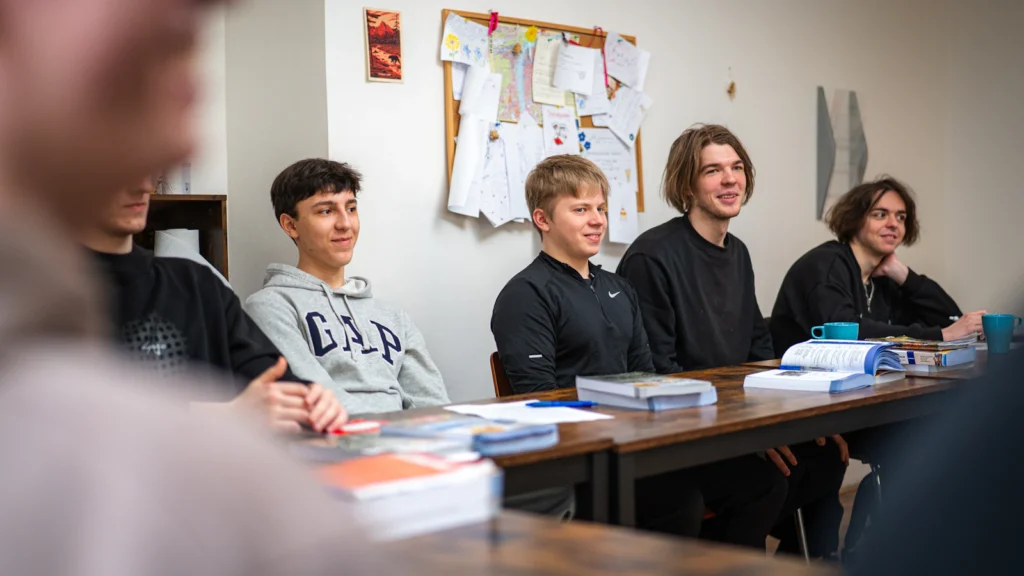
High-school students can spot a childish filler activity immediately. A good pre-break game needs a clear challenge, a short explanation and enough choice that nobody is forced to perform. These Thanksgiving classroom games use the board, students’ own paper or no supplies at all. They work in advisory, homeroom, ELA, electives and the final ten to forty minutes before break.
Quick answer: For ten minutes, use Category Ladder, Thanksgiving Headline or Five-Second Debate. For a full period, combine Silent Ranking, Mystery Menu and One-Minute Documentary. For a quiet class, choose Micro-Story Relay or Evidence-Based This or That.
Quick chooser for teachers
| Situation | Best game | Time |
|---|---|---|
| Five-minute gap | Category Ladder, Odd One Out | 5–8 minutes |
| Quiet independent start | Micro-Story Relay, Headline Challenge | 8–12 minutes |
| Team collaboration | Mystery Menu, One-Minute Documentary | 12–20 minutes |
| No seasonal celebration | Autumn Logic, Appreciation Chain | 8–15 minutes |
15 Thanksgiving games high-school students will actually play
1. Category Ladder
Write a broad category on the board: autumn activities, foods served warm, things people gather for or ways to help a community. Teams alternate answers, but each new answer must contain more letters than the previous one. Give 20 seconds to consult. No student is eliminated.
2. Thanksgiving Headline Challenge
Groups turn an ordinary event—burned rolls, an early bus, a missing serving spoon—into a dramatic six-word headline. Examples: “Local Pie Vanishes Before Guests Arrive.” Award optional titles for clearest, funniest and most believable rather than naming one winner.
3. Five-Second Debate
Offer a harmless choice: pie or cookies, parade or movie, early dinner or late dinner. Students select a side by hand signal. Give one volunteer from each side exactly five seconds to make a case. Switch topics before the class gets stuck arguing.
4. Silent Ranking
Display five items to rank, such as sleep, food, music, games and travel. Teams must agree on one order while speaking for only the first minute; after that, communication is by gesture or written notes. Debrief which collaboration strategy worked.
5. Mystery Menu
Teams invent a three-course meal using five ordinary ingredients named by the teacher. No tasting or food is needed. They must give each dish a name, explain the preparation in one sentence and identify the intended audience. Keep ingredients allergy-neutral because the activity is imaginary.
6. Micro-Story Relay
Students write a two-sentence autumn or gathering story. After one minute, they pass it to a partner who adds exactly one sentence. Repeat twice, then the original writer creates a final line. Reading aloud is optional; teams may submit a favorite anonymously.
7. Odd One Out—Defend It
Write four words: leaf, sweater, pumpkin, umbrella. Students choose the odd one out and defend the choice with evidence. Multiple answers can be correct. The reasoning matters more than guessing the teacher’s answer.
8. One-Minute Documentary
Teams plan a sixty-second documentary about an ordinary seasonal topic: cafeteria leftovers, changing weather, the busiest hallway or the science of sleep after a big meal. They need a title, opening line and three shots. No filming is required.
9. Appreciation Chain Without Names
Each student writes one specific thing that improves the class—clear instructions, shared notes, patience during group work. Collect and read a selection without names. Avoid requiring personal gratitude or identifying classmates; focus on actions and classroom culture.
10. Forbidden Word Conversation
Choose one common but harmless word such as “food,” “school” or “weekend.” Pairs discuss a prompt for one minute without using it. If the word slips out, they simply restart the sentence. Rotate prompts rather than keeping score.
11. Thanksgiving Survey Showdown
Ask students to predict the class’s most popular answer to questions such as ideal break activity or best leftover. Take a quick anonymous hand vote, then teams compare predictions with results. This teaches estimation without copying a television format.
12. The 30-Second Expert
Give students a neutral topic they already know—making toast, choosing a playlist, packing a bag. They explain it clearly in 30 seconds to a partner, who asks one useful follow-up. The challenge is clarity, not comedy or public speaking.
13. Autumn Logic Links
Place three words on the board, such as rain, bus and cocoa. Teams create the strongest logical connection in one sentence. Then they supply a new set for another team. Ban connections based only on “they are all words.”
14. Before-or-After Timeline
Read ordinary gathering events: guests arrive, oven preheats, leftovers are labeled, tables are cleared. Teams arrange them into a sensible order, then deliberately redesign the sequence for a different setting such as a school event or picnic.
15. Exit-Ticket Game Design
Students invent a two-minute game with three constraints: no special supplies, everyone can participate and the rules fit in two sentences. Partners test the explanation, not necessarily the full game. Save the clearest ideas for future class breaks.
A ready 40-minute plan
- 5 minutes: Category Ladder warm-up.
- 10 minutes: Silent Ranking in groups.
- 15 minutes: Mystery Menu or One-Minute Documentary.
- 7 minutes: Odd One Out—Defend It.
- 3 minutes: Exit-Ticket Game Design.
Keep the games mature and inclusive
- Offer written, paired and pass options before any public speaking.
- Do not use elimination, food tasting, religious assumptions or family-pressure prompts.
- Use “autumn,” “break” or “gathering” language when Thanksgiving is not celebrated by everyone.
- Keep debates low-stakes and stop before they become personal.
- Reward reasoning, clarity and cooperation instead of speed alone.
- State the end condition before starting so the activity does not consume the lesson.
For younger grades, use our Thanksgiving games for middle school. Teachers wanting a non-holiday option can use these fall indoor games for teens, while October classes can use the separate high-school Halloween games.
If your group can use simple classroom supplies, add faster competition with these Thanksgiving minute-to-win-it games for teens and classrooms.
Frequently asked questions
What is the easiest no-prep Thanksgiving game for high school?
Odd One Out—Defend It is easiest because the teacher needs only four words and students can respond verbally or in writing. It works in five minutes and supports multiple correct answers.
How do I avoid activities that feel childish?
Use constraints, reasoning and short team decisions rather than costumes, animal motions or elementary worksheets. Explain the purpose and keep rounds moving.
Can these games fit an academic class?
Yes. Micro-Story Relay supports writing, Odd One Out develops reasoning, Silent Ranking practices collaboration and Mystery Menu develops concise presentation skills.
What if students do not celebrate Thanksgiving?
Use autumn, community and end-of-term prompts. None of the game mechanics requires a religious or family tradition, and students should always be able to pass on personal questions.
Leave a Reply