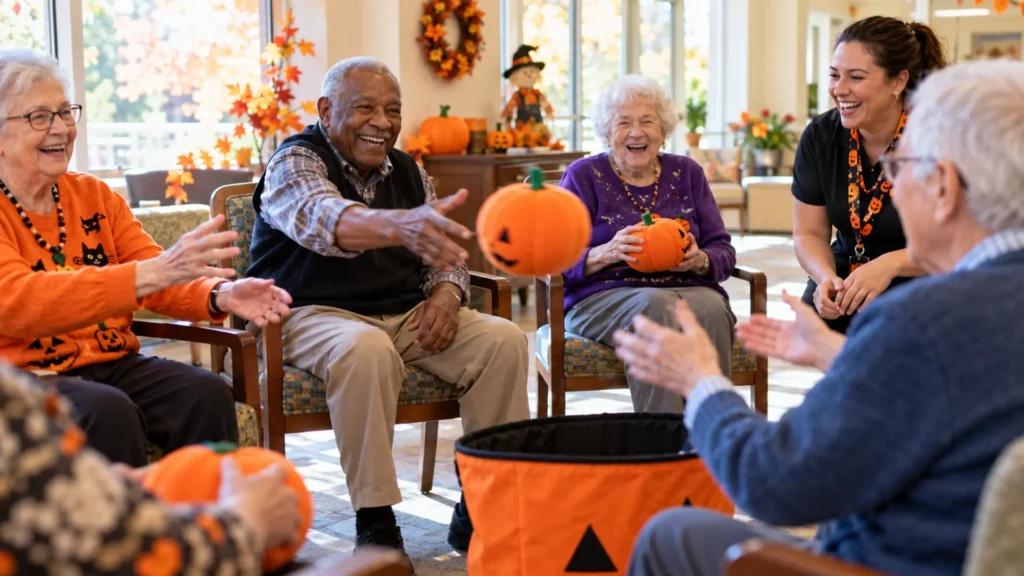
A good Halloween activity for older adults should be social, easy to understand, and adaptable to different mobility, vision, hearing, and memory needs. The games below work for assisted-living communities, senior centres, day programmes, family gatherings, and small home celebrations. Most can be played seated, and none requires fast running or complicated equipment.
Quick chooser
- Best seated games: Pumpkin Pass, Mystery Bag, Halloween Name That Tune, and Finish the Spooky Phrase.
- Best for mixed abilities: Picture Bingo, Giant Pumpkin Toss, Costume Detail Detective, and Halloween Categories.
- Best with no supplies: Spooky Would You Rather, Memory Lane, Halloween Charades, and True or False.
- Best for a 20-minute programme: Pumpkin Pass, Name That Tune, and one team quiz.
17 Halloween games for seniors
1. Pumpkin Pass
Seat everyone in a circle and pass a soft orange ball, fabric pumpkin, or rolled orange towel while music plays. When the music stops, the holder answers a light seasonal question such as “Which autumn smell do you enjoy?” or “Would you choose a funny costume or a fancy costume?” Nobody is eliminated, and participants may pass on any question.
2. Halloween Picture Bingo
Use large-print cards with clear pictures such as a pumpkin, black cat, moon, broom, candle, apple, hat, and leaf. Show and name each picture as it is called. Avoid crowded cards and tiny text. Play for one line first, then continue to a full card if the group is enjoying it.
3. Giant Pumpkin Toss
Place a laundry basket or wide box a comfortable distance away. Players toss soft orange beanbags, rolled socks, or foam balls into the “pumpkin patch.” Give everyone three attempts and adjust the distance individually. Count the group’s total rather than ranking players.
4. Halloween Name That Tune
Play or hum a few seconds of familiar seasonal songs and film themes. Invite players to name the tune, performer, decade, or a memory connected with it. Keep the volume comfortable and provide verbal clues. Teams can discuss before answering so no one feels put on the spot.
5. Mystery Touch Bag
Place safe, familiar objects in an opaque bag: a pinecone, soft scarf, plastic apple, wooden spoon, small brush, or smooth stone. Each person feels one object without looking and describes its shape and texture before guessing. Skip sticky, sharp, frightening, or food items that may cause allergies.
6. Halloween Categories
Name a category—orange things, autumn foods, costume ideas, famous fictional cats, or words beginning with B. Go around the group for answers, allowing repeats if memory support is helpful. For a team version, give one minute to create the longest list.
7. Costume Detail Detective
Show one volunteer wearing three or four simple accessories, such as a hat, scarf, badge, and glasses. After 20 seconds, the volunteer steps out or turns around and changes one item. The group identifies what changed. Use bold colours and large objects for visibility.
8. Finish the Spooky Phrase
Read the beginning of a familiar phrase, title, or rhyme and let the group complete it. Examples include “Trick or…,” “Once upon a…,” and “The itsy-bitsy….” Mix seasonal prompts with well-known sayings so the activity remains accessible.
9. Soft Pumpkin Bowling
Arrange six lightweight cups as pins and roll a soft orange ball from a seated or standing position. Reset the cups after each turn. A helper can steady the ramp, retrieve the ball, or move the pins closer. Cheer each successful knockdown without keeping an individual leaderboard.
10. Spooky Would You Rather
Ask friendly choices: “Would you rather visit a pumpkin patch or an apple orchard?” “Wear a wizard hat or a superhero cape?” “Hear a funny ghost story or solve a mystery?” Players can answer with a hand signal, coloured card, or spoken response, then explain if they wish.
11. Halloween Memory Lane
Offer optional prompts about past autumn traditions: favourite sweets, school parties, neighbourhood decorations, harvest meals, or costumes seen in films. Keep questions open and never require a personal memory. Participants may instead describe how celebrations have changed over time.
12. Seated Halloween Charades
Players act out simple prompts using their hands, face, or upper body: stirring a cauldron, opening an umbrella, carving a pumpkin, spotting a bat, or putting on a cape. Partners may perform together. Give the answer after 30 seconds so the pace stays relaxed.
13. True or False: Autumn Edition
Read simple statements and let participants show thumbs up or down. Mix facts and playful questions: “Pumpkins are fruits,” “Owls sleep only at night,” or “Every apple is red.” Explain the answer briefly. Avoid trick wording that depends on hearing one small word.
14. Pumpkin Price Is Right
Display three or four familiar seasonal items and invite estimates of their current price. Use photographs if shopping items are unavailable. Reveal a reasonable local price range, then discuss how prices or packaging have changed. This combines conversation with gentle number work.
15. Halloween Word Build
Write HALLOWEEN in large letters. Individuals or teams make shorter words using its letters, such as “hall,” “when,” “low,” and “new.” Accept spoken answers and let a facilitator write them. For an easier version, ask for any word beginning with each letter.
16. Friendly Ghost Hunt
Hide large paper ghosts at eye level around one room. Give verbal clues and invite participants to point them out from their seats or walk with support. Number the ghosts so the group knows how many remain. Never place clues near stairs, floor obstacles, or private areas.
17. Group Pumpkin Story
Begin with “A small pumpkin rolled away from the garden gate.” Each person adds a sentence, a word, or chooses between two suggested directions. A facilitator repeats the developing story after every few turns. End after one complete adventure and give the pumpkin a cheerful name.
A ready-to-run 30-minute programme
- Minutes 0–5: Spooky Would You Rather as a warm-up.
- Minutes 5–12: Pumpkin Pass.
- Minutes 12–20: Picture Bingo or Halloween Categories.
- Minutes 20–27: Name That Tune.
- Minutes 27–30: Group Pumpkin Story and a calm close.
How to adapt the games safely
Offer seated and standing versions, keep walkways clear, and use soft, lightweight objects. Use large print, strong colour contrast, one instruction at a time, and a demonstration before starting. Reduce background music while explaining rules. Ask staff or family caregivers about individual participation needs, and never make speed, perfect recall, or physical strength the only way to succeed.
Make participation comfortable
Let every player choose to answer, partner up, observe, or pass. Avoid surprise touches, loud jump scares, graphic decorations, and activities that require sharing personal information. Cooperative class totals—such as knocking down 20 pins together—usually create a warmer atmosphere than elimination.
More Halloween group games
For a wider adult gathering, use these Halloween party games for adults. Mixed-age families can try Halloween games at home with no special supplies, while bigger groups may prefer no-prep large-group games.
For a broader autumn program before or after Halloween, try these fall games for seniors in nursing homes and assisted living.
Frequently asked questions
What are the easiest seated Halloween games for seniors?
Pumpkin Pass, Picture Bingo, Halloween Categories, Name That Tune, and Finish the Spooky Phrase all work well around a table or in a seated circle.
How long should an assisted-living Halloween activity last?
A focused 20- to 30-minute session is often easier to manage than one long event. Offer an optional second activity rather than requiring everyone to stay.
How can a game include people with different abilities?
Use teams, partners, large visual cues, spoken instructions, and multiple ways to respond. Reward participation and teamwork instead of speed or memory alone.
Featured photo by Steven Aguilar on Unsplash.
Leave a Reply